


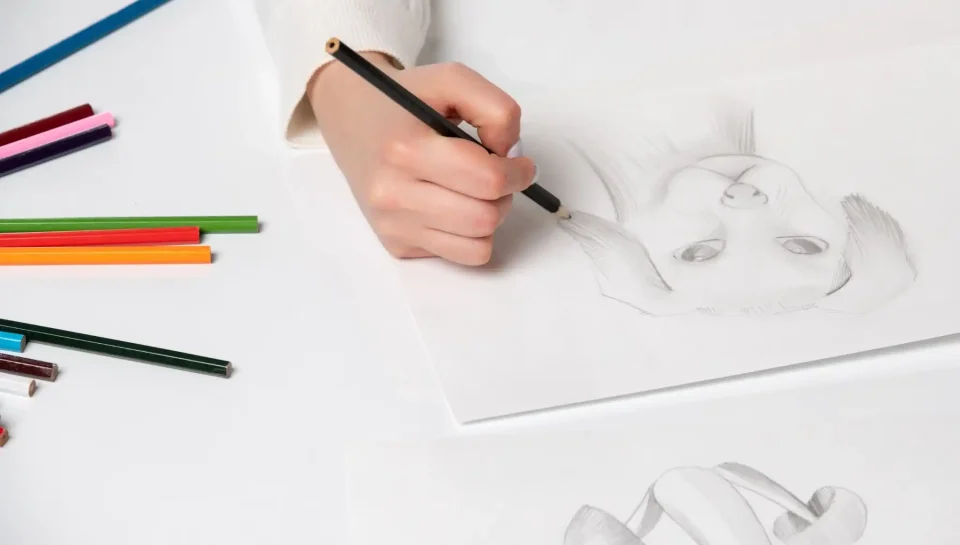
Drawing is one of the most universal ways to express creativity. Whether you’re sketching as a hobby, building your artistic foundation, or preparing for design or illustration work, learning the essentials gives you confidence and control. Most beginners believe drawing requires talent, but the truth is that drawing is a skill built through practice, observation, and understanding a few fundamental techniques.
This guide breaks down the core drawing skills every beginner must learn. You’ll explore simple methods, clear explanations, and practical exercises that help you build a strong artistic foundation. These techniques are timeless and apply to every style, realism, cartoons, digital art, character design, architecture, or abstract drawing. By the end, you’ll have a roadmap that makes drawing less intimidating and more enjoyable.
Start With What You See, Not What You Know
The first essential technique in drawing is learning to observe. Beginners often rely on assumptions, drawing a symbol of a face, a tree, or a house instead of what those objects truly look like in front of them. Artists learn to slow down and look carefully at shapes, proportions, angles, shadows, and edges.
Practice observing objects around you before drawing them. Notice:
- How the light hits them
- How edges curve or angle
- The empty spaces around the object
- The true proportions
Observation is a skill, and like any skill, it strengthens with repetition. When your eyes become more accurate, your drawings naturally improve.
Break Everything Into Simple Shapes
Every complex object can be simplified into basic shapes. When beginners skip this step, drawings often become distorted. By starting with circles, rectangles, cubes, cylinders, and cones, you build a solid structure for your final sketch.
For example:
- A human torso begins as a box or cylinder
- A tree trunk begins as a cylinder
- A car can be broken into rectangles and trapezoids
- A face starts as an oval with guiding lines
This technique helps with proportion, perspective, and accuracy. Think of simple shapes as the skeleton of your drawing. Once they’re correct, adding details becomes much easier.
Master Line Confidence and Line Quality
Lines are the foundation of your drawing language. Beginners often struggle with shaky, stiff, or overworked lines. Learning to draw confident, clean lines improves your sketches instantly.
Here are techniques to practice:
1. Ghosting Lines
Hover your hand above the paper before drawing the line. This helps you plan movement and improves accuracy.
2. Using Long, Smooth Strokes
Instead of short, scratchy lines, use long strokes from your elbow or shoulder. This creates more professional, fluid results.
3. Line Weight Variation
Use thicker lines for foreground objects and thinner lines for background elements. This creates depth and adds style.
4. Controlled Pressure
Practice drawing lines that gradually get lighter or darker. Controlling pressure gives life to simple sketches.
Strong line quality separates beginner drawings from more refined ones.
Understanding Proportions
Proportion is the relationship between the size of different parts of a drawing. Getting proportions right is one of the biggest challenges for beginners. Even small inaccuracies can make a drawing look “off.”
Here are simple proportion techniques:
Comparative Measurement
Use your pencil as a measurement tool. Compare lengths and angles by holding your pencil at arm’s length.
Blocking In
Start with large shapes and rough outlines, then refine. This helps you avoid mistakes early.
Negative Space Awareness
Instead of drawing the object, draw the shapes around it. This automatically improves proportion accuracy.
Guidelines
Use center lines, angle lines, and cross-sections to keep shapes aligned.
Proportion improves dramatically when you learn to measure instead of guess.
Light, Shadow, and Value
Shading transforms flat drawings into three-dimensional forms. Understanding light and shadow is essential for realistic drawing.
Key Concepts
- Light Source: Identify where the light is coming from.
- Highlight: The brightest area affected by direct light.
- Mid-tones: The normal tones of the object.
- Core Shadow: The darkest part of the shadow.
- Cast Shadow: The shadow the object creates on a surface.
- Reflected Light: The lighter edge inside the shadow created by light bouncing nearby.
Shading Methods
1. Hatching: Parallel lines that create tone.
2. Cross-Hatching: Overlapping hatching lines to add darkness.
3. Stippling: Dots to build texture and slow gradients.
4. Smooth Shading: Soft, blended transitions using paper stumps or tissues.
Good shading comes from noticing gradual transitions, not rushing into dark tones immediately.
Perspective Basics for Beginners
Perspective teaches you how to draw objects the way they appear in real space. Without perspective, drawings look flat or distorted.
1-Point Perspective
All lines converge at one vanishing point. Used for hallways, roads, and simple interiors.
2-Point Perspective
Two vanishing points on the horizon line. Useful for buildings and boxes.
3-Point Perspective
Adds a vertical vanishing point. Creates dramatic up-or-down views of tall structures.
Beginners should master 1- and 2-point perspectives first. Once you understand how vanishing points work, drawing environments becomes much easier.
Gesture Drawing: Movement Over Detail
Gesture drawing trains you to capture movement, posture, and energy quickly. Instead of focusing on details, you interpret the flow of the subject.
Gesture drawing helps you:
- Improve speed
- Loosen your hand
- Understand body movement
- Capture emotion
- Avoid stiffness
Start with 30-second or 1-minute poses. The goal is not accuracy but energy. Gesture is essential for character drawing, figure drawing, and animation.
Textures and Surface Detail
Texture gives drawings personality and realism. Whether you’re drawing wood grain, fabric folds, fur, hair, or stone, each material has different patterns and line qualities.
When practicing texture:
- Start by studying the material closely
- Identify repeating patterns
- Use short strokes for soft textures
- Use sharp lines for hard textures
- Layer lines gradually rather than forcing detail
Textures improve with patience and attentive observation.
Using References and Studying Real Life
Many beginners try to draw from imagination too soon. While imagination is important, foundational skills come from studying real objects, photos, and environments.
Benefits of using references:
- Better accuracy
- Improved understanding of light
- Increased confidence
- Exposure to new visual ideas
- Stronger sense of proportion
As you grow, imagination and memory become easier to use effectively.
Building a Practice Routine
Drawing isn’t mastered in a weekend. Consistency matters far more than long, rare sessions.
A strong practice routine includes:
- Daily warm-up lines
- Quick sketches of objects
- Shape practice
- Gesture drawing
- Light and shadow exercises
- Short study sessions from life
Even 10–20 minutes per day creates noticeable improvement.
FAQs
1. What is the best way for beginners to start learning drawing fundamentals?
The best approach is to begin with simple shapes, basic line control, and observation exercises. Focusing on circles, squares, and cylinders helps build structure and accuracy. Pair this with daily practice and studying real-life references to strengthen your understanding of proportion, form, and shading in a natural, steady way.
2. How often should beginners practice to see real improvement?
Consistent short practice sessions create the fastest progress. Drawing for 15–30 minutes daily is more effective than long weekly sessions. Regular repetition builds muscle memory, improves coordination, and sharpens observation. Over a few months, beginners typically notice big improvements in proportion, shading, and confidence.
3. Why do beginner drawings often look flat or unrealistic?
Drawings usually look flat because shading, light direction, and perspective are not fully understood. When beginners learn how light hits an object and how shadows form, their drawings gain depth. Adding basic perspective and value contrast helps transform flat sketches into drawings that feel dimensional and visually convincing.
Conclusion
Foundational drawing techniques give every beginner the tools they need to develop confidence and control. When you focus on observing accurately, practicing simple shapes, mastering line quality, understanding proportions, and applying light and shadow effectively, your drawings naturally improve. Drawing is not about perfection but progress, and each practice session brings you closer to the artist you want to become.
Keep exploring, stay curious, and enjoy the learning process. Every sketch is a step forward.